Smoke alarms are the one piece of electrical equipment in a house that everyone owns, nearly everyone ignores, and almost nobody checks until it chirps at three in the morning.
They’re also the piece with the clearest rules attached — particularly if you rent out a property. Here’s what’s actually required in New South Wales, and what’s simply good practice.
What the law requires in NSW
Every home in New South Wales must have at least one working smoke alarm installed on each level. That applies to owner-occupied houses, rentals, relocatable homes and caravans alike.
For rental properties the obligations go further. Landlords are responsible for ensuring smoke alarms are installed and kept working, and for repairing or replacing a faulty alarm within the timeframe set out in the tenancy rules once they’re notified. Tenants are responsible for reporting faults. If you’re a landlord or managing agent, check the current NSW Fair Trading guidance — the detail around timeframes and record-keeping has changed more than once.
If you own an investment property, the practical upshot is that “the tenant said it was fine” is not a defence. A documented annual check is.
Hardwired versus battery
Both are legal in an existing home, but they’re not equivalent.
Battery-only alarms are what most older houses have. They’re cheap and simple, and they fail silently — a flat battery or an alarm past its life span looks identical to a working one.
Hardwired alarms run off mains power with a backup battery. They can’t be disabled by pulling a battery out, and they’re the standard for new builds and significant renovations. If you’re already having electrical work done, adding them is far cheaper than a standalone job later.
Interconnected alarms are the meaningful upgrade. When one alarm detects smoke, every alarm in the house sounds. In a two-storey home where the fire starts downstairs and the bedrooms are upstairs, that difference is the entire point. Interconnection can be wired or wireless, and wireless makes retrofitting realistic in a house that’s already lined and painted.
Photoelectric, and why it matters
There are two sensing technologies. Ionisation alarms respond marginally faster to fast-flaming fires; photoelectric alarms respond considerably faster to smouldering fires — the kind that start in furniture, bedding or electrical wiring and fill a house with smoke while everyone is asleep.
Fire services across Australia recommend photoelectric alarms, and they’re what we install. They’re also less prone to the cooking-related false alarms that lead people to take the battery out — which is the single worst outcome of all.
Where they need to go
Placement matters as much as the alarm itself:
- On every level of the home.
- In hallways outside bedrooms, and ideally inside bedrooms where people sleep with the door closed.
- On the ceiling, at least 300mm away from walls and the corner where ceiling meets wall — dead air in corners delays detection — and clear of light fittings and air vents.
- Away from bathrooms, and not directly outside the kitchen where steam and cooking cause nuisance alarms.
- Not in the path of ceiling fans or air conditioning outlets.
The ten-year rule almost nobody knows
Smoke alarms expire. The sensor degrades whether or not the alarm has ever been triggered, and manufacturers give them a service life of ten years from the date of manufacture — not the date you installed it.
Turn yours over. There’s a date printed on the back. If it’s more than ten years old it needs replacing regardless of how healthy it seems, and if there’s no date at all, it’s old enough that the answer is the same.
This is the most common thing we find in homes that have “working” alarms: units from a decade ago, still beeping happily when tested, well past the point where the sensor can be relied on.
A maintenance routine that actually gets done
- Monthly: press the test button until it sounds. Ten seconds.
- Every six months: vacuum the outside with a brush attachment. Dust and insects are a leading cause of false alarms.
- Yearly: replace the battery in battery-only and backup-battery units, unless it’s a sealed ten-year lithium unit.
- Every ten years: replace the alarm entirely.
The three-in-the-morning chirp, incidentally, is a low battery warning. It happens overnight because the temperature drop reduces battery voltage just enough to trigger it.
When to get an electrician involved
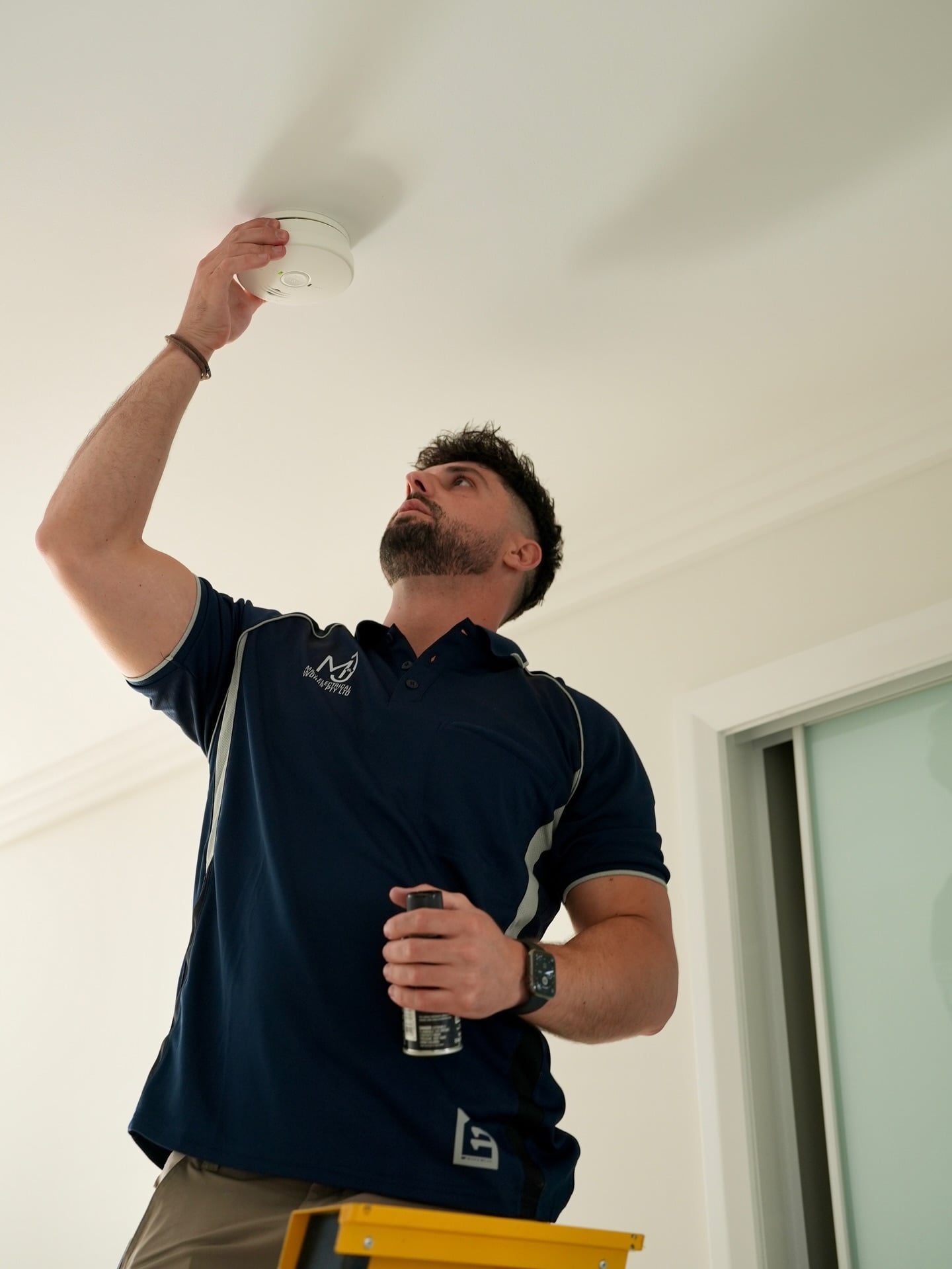
Battery replacement and testing are homeowner jobs. Anything involving mains-powered alarms — installing them, replacing hardwired units, or adding interconnection — is licensed electrical work.
It’s worth doing properly if you’re a landlord needing documented compliance, if your alarms are battery-only in a two-storey home, if they’re past ten years old, or if you’re already having other work done and the marginal cost is small.
We install and test smoke alarms across Western and South-Western Sydney, including interconnected photoelectric systems in existing homes. If you’re not sure what you’ve got or how old it is, send us a message — it’s a quick thing to check and an easy thing to put off for years.