Count the double adaptors in your house. If the answer is more than one or two, the house is telling you something: it was wired for a different era, when a living room needed a lamp and a television and that was about it.
Adding power points is routine work, and it’s also one of the easiest jobs to get wrong, not electrically but in planning. People add one outlet where they needed three, or put them where the furniture isn’t. Here’s how to think it through before anyone drills a wall.
The honest answer: count your devices, then add two
There’s no regulation that says a bedroom must have four outlets. The wiring rules set minimum safety requirements, not a shopping list for convenience. So the practical approach is simply to count what actually plugs in, including the things that live plugged in permanently, and then allow a couple spare.
The spare capacity matters more than people expect. Outlets are cheap while the walls are open or while an electrician is already on site; they’re expensive as a separate call-out eighteen months later.
Room by room
Kitchen. The busiest room in the house for power. Bench appliances multiply: kettle, toaster, coffee machine, microwave, air fryer, blender. Doubles spaced along the bench are far more useful than one bank in a corner. Keep in mind that fixed appliances (oven, cooktop, dishwasher, rangehood) usually have their own dedicated supply and shouldn’t be sharing a bench outlet.
Living room. The TV wall is the pinch point: television, soundbar, console, streaming box, modem if it lives there. That’s five plugs behind one cabinet. A quad outlet behind the TV solves it far more neatly than a power board on the carpet. Then a couple of outlets on the opposite wall for lamps and the vacuum.
Bedrooms. Two either side of the bed is the modern minimum: phones, lamps, clocks, a fan in summer. If a desk lives in the room, that’s another. Bedside outlets are a frequent retrofit, usually because the original wiring put a single outlet behind where the wardrobe now sits.
Home office. Easily underestimated. Computer, monitor or two, dock, printer, desk lamp, phone charger, and increasingly a second workstation. Treat it like a small kitchen bench.
Laundry. Washer, dryer, and something for an iron or a stick vacuum on charge. If the dryer is wall-mounted, the outlet needs to be positioned for it rather than behind the machine.
Garage. Workshop tools, a second fridge or freezer, and (worth thinking about now even if it’s years away) an EV charger. A charger isn’t a power point job; it needs its own circuit from the board. But knowing it’s coming changes what we’d recommend doing today.
Outdoors and alfresco. Weatherproof outlets for the barbecue area, Christmas lights, or a pump. These must be rated for the location and protected accordingly. An indoor outlet on an external wall isn’t acceptable.
Double adaptors are a symptom, not a solution
Piggyback plugs and stacked adaptors concentrate load on a single outlet that was never designed for it. The common failure isn’t dramatic. It’s a warm plug, a discoloured faceplate, or a socket that’s become loose over years of tugging. All three are worth acting on rather than ignoring.
Power boards with their own overload protection are a reasonable temporary measure. Two boards daisy-chained together are not. If you’re running that arrangement permanently, an extra outlet is cheaper than the alternative.
Can you add outlets without rewiring the whole house?
Usually, yes, and the answer is more encouraging than most people expect.
In many cases a new outlet can be taken from an existing circuit nearby, with the cable run through the wall cavity or ceiling space. In a single-storey home with accessible roof space, that’s often straightforward. Double-storey, concrete or rendered walls, or a downstairs room with a tiled floor above take more work. Sometimes the cable route is the whole job.
A new circuit back to the switchboard becomes necessary when the existing one is already carrying enough, or when the new load is significant. New and altered circuits require RCD (safety switch) protection under the current wiring rules, which is another reason older boards sometimes need attention before extra outlets go in.
What we’d caution against is deciding in advance that it’ll be simple or that it’ll be a nightmare. Neither is knowable until someone has looked in the roof space and at the board.
Are USB and quad outlets worth it?
Quad outlets, generally yes. Behind a TV or beside a desk, four sockets in the footprint of a double is genuinely useful and costs little more than the double it replaces.
Built-in USB is more of a judgement call. It’s tidy and it frees a socket, and in a bedside or kitchen bench location people do use them daily. The honest caveat is that USB standards move faster than power points do: an outlet fitted today will still be a perfectly good outlet in fifteen years, but its USB ports may well be an obsolete shape and a slow charge rate long before that. If you want them, put them where they’ll be used every day and keep normal sockets elsewhere.
What a tidy job looks like
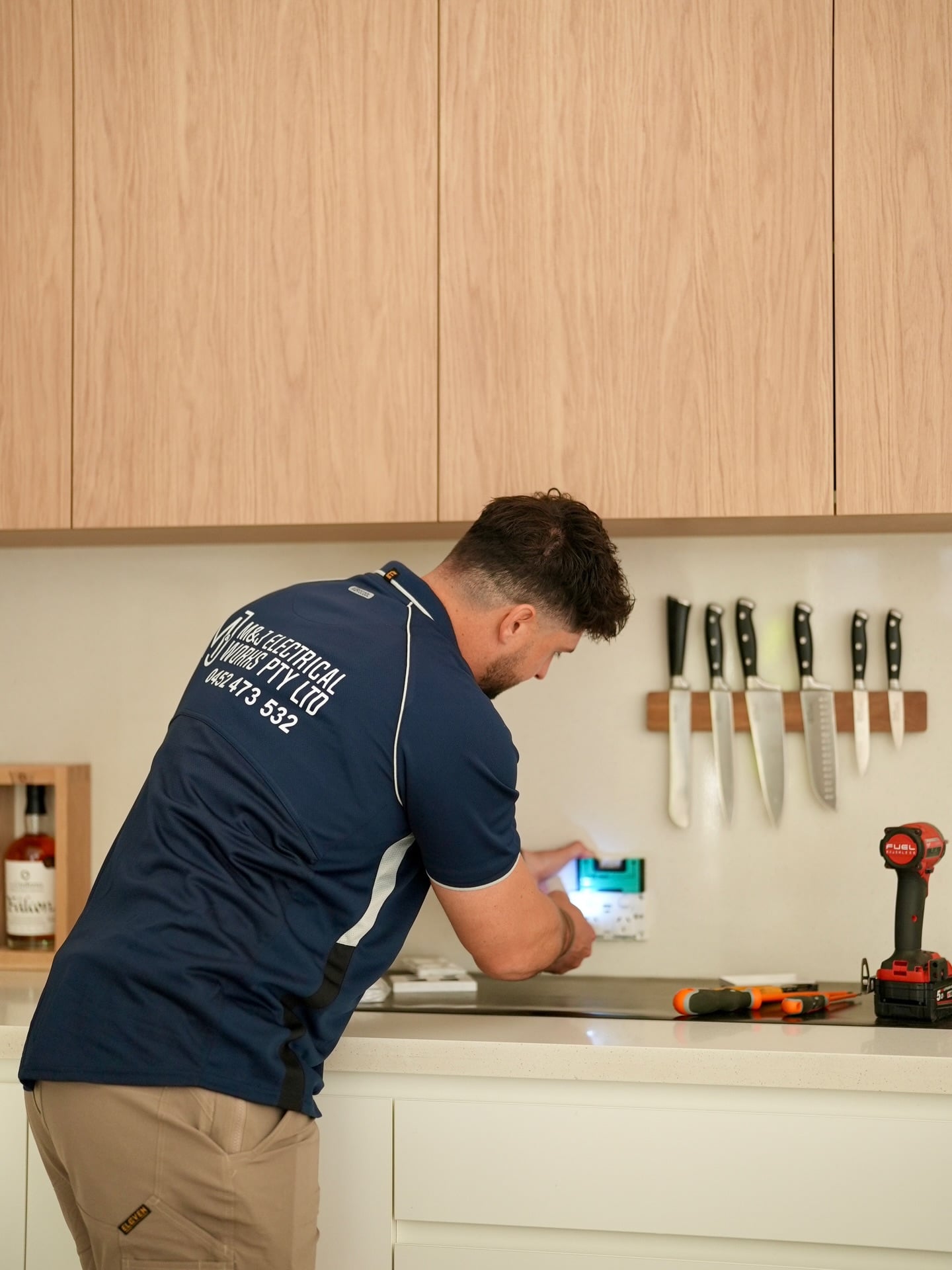
The electrical part of adding an outlet is not the hard part. The difference between a good job and a rough one is everything around it: plates that line up with the ones already in the room and sit flush to the wall, cable routed properly rather than taking the shortest destructive path, minimal patching, and the patching that is needed left clean and ready for paint rather than smeared and left for you.
It’s worth asking any electrician what they’ll do about making good before they start, and whether the new plates will match your existing range. Mismatched switch plates in the same room are a small thing that you’ll notice every day afterwards.
Before you book
- Walk each room and count what’s plugged in, including things hidden behind furniture.
- Mark where you want outlets, not where they currently are.
- Note anything that’s on a double adaptor or a permanent power board. That’s your priority list.
- Think about the next few years: EV charger, air conditioning, a home office that’s becoming permanent.
- Check whether your switchboard has spare capacity, or ask us to look while we’re there.
Only a licensed electrician can add or alter fixed wiring in New South Wales, and any new work should come with a certificate of compliance for electrical work. If someone offers to add outlets without one, that’s a reason to keep looking.
We do power point installations across Western and South-Western Sydney, from a single bedside outlet to a full kitchen bench. If you’d like a look at what’s involved in your place, send us a message and we’ll give you a straight assessment.