
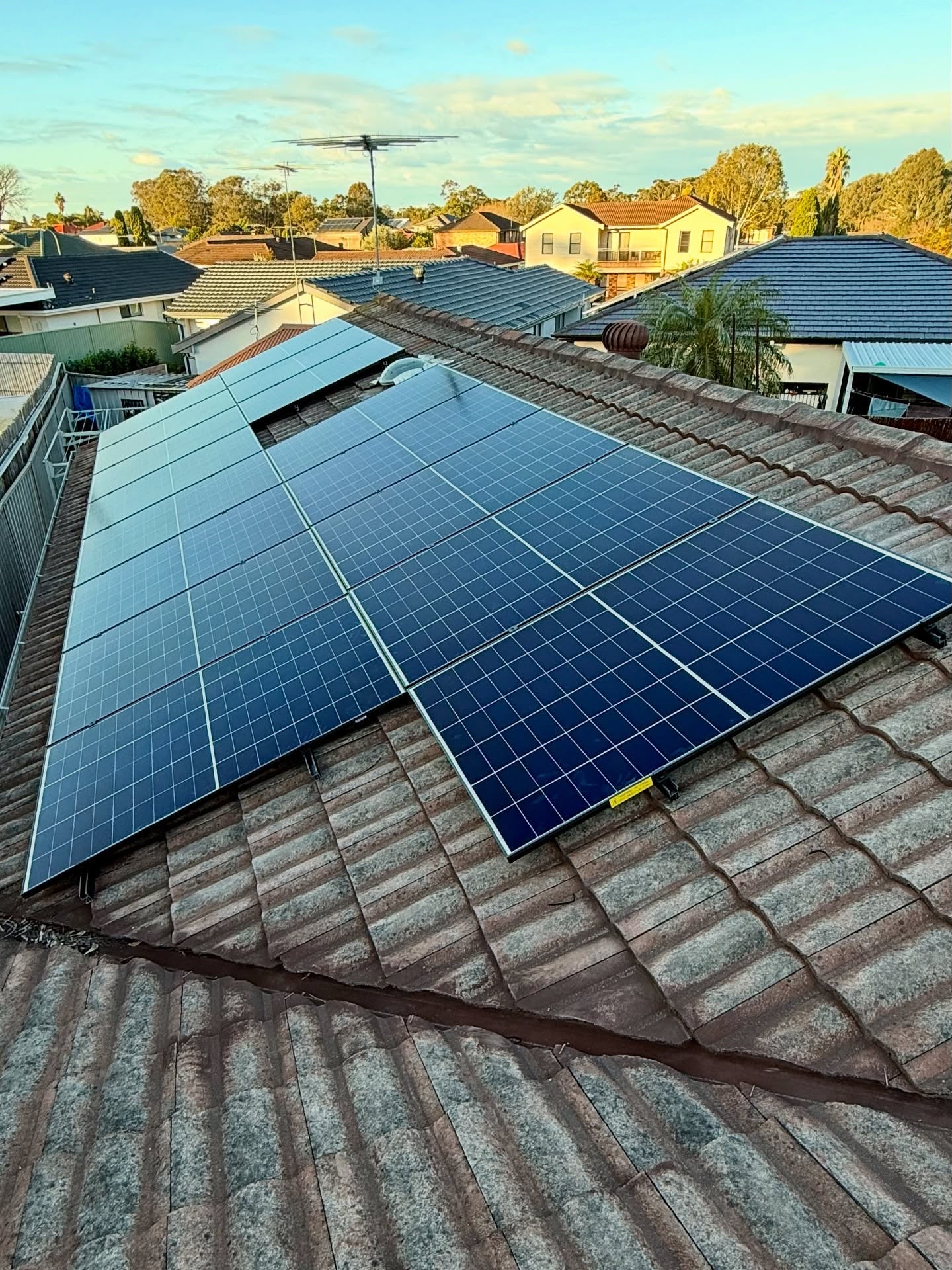
Adding a battery is a natural next question once solar is up and running. The panels are working, the daytime bills have dropped, and the obvious next step is storing some of that power for the evening. Whether that turns out to be a straightforward job or an expensive one usually comes down to a few things that have nothing to do with the battery itself.
Here’s what actually determines the answer, in the order we check it.
Start at the switchboard, not the battery
The first thing we look at isn’t the battery brand. It’s your switchboard. A battery adds another supply into your home’s electrical system, and that system has to be able to accommodate it safely.
In a lot of Western Sydney homes, particularly anything built before the mid-1990s, the board is already full. Older boards were never designed for solar, let alone solar plus storage plus an EV charger down the track. If yours still has ceramic fuses or rewireable fuses, or there’s simply no physical room left on the rail, the switchboard work becomes part of the battery job rather than a separate project.
That’s not a reason to walk away. It’s a reason to price it properly up front instead of discovering it halfway through. If you’re likely to need a switchboard upgrade anyway, doing it at the same time as the battery saves paying for two visits and two isolations.
Is your inverter battery-ready?
This is where a lot of quotes diverge, and it’s worth understanding before you compare them.
- Hybrid inverter already installed: if your original installer fitted a hybrid (battery-ready) inverter, you may be able to add compatible storage without replacing it. This is the cheapest path.
- Standard solar inverter: most systems installed a few years ago used a straight solar inverter with no battery capability. You then have two options: replace the inverter with a hybrid, or add an AC-coupled battery that has its own built-in inverter and sits alongside the existing system.
Neither approach is automatically better. AC-coupled batteries avoid touching a perfectly good solar inverter and are often simpler to retrofit. Replacing with a hybrid can be tidier and slightly more efficient overall. What matters is that whoever quotes you explains which approach they’re proposing and why, because the two can differ significantly in cost.
One thing worth checking: compatibility is usually brand-specific. A battery and inverter from the same manufacturer will generally talk to each other properly, with one app and one warranty conversation. Mixed systems can work well, but they need someone who has actually commissioned that combination before.
Where the battery physically goes
Home batteries are heavy, they need ventilation, and they don’t love heat. Installation of battery systems is covered by its own Australian standard, which sets out clearances and where units can and can’t be mounted, including restrictions around habitable rooms and escape paths.
In practice, the usual spots are a garage wall, an external wall in shade, or a dedicated plant area. A west-facing brick wall that bakes all afternoon is a poor choice in a Sydney summer, even if it’s the most convenient one. Somewhere shaded, ventilated and away from the main path out of the house is what we’re looking for.
Cable run matters too. The further the battery sits from the switchboard and inverter, the more cable, conduit and labour goes into it.
What your network operator allows
Grid connection isn’t automatic. Across most of Western and South-Western Sydney the distribution network is Endeavour Energy, and any change to your generation or storage setup needs their approval before it’s connected. There are limits on how much you’re permitted to export back to the grid, and those limits depend on your supply. Single-phase properties are more constrained than three-phase ones.
This is normal paperwork and your installer should handle it, but it’s a real step with a real timeline. Be cautious of anyone who tells you approval isn’t needed.
Size it around your evenings, not your roof
The most common sizing mistake is picking a battery to match the solar system rather than the household.
A battery earns its keep by covering the hours when you’re using power and the panels aren’t producing, roughly late afternoon through to morning. So the useful question isn’t “how big is my system?”, it’s “how much power do we actually use between about 5pm and 7am?”
If everyone’s out during the day and home in the evening, storage suits you well. If the house runs air conditioning, a pool pump and a workshop through the middle of the day, you may be better served by using more of that solar directly before you spend money storing it.
Have a look at your bill or your inverter app for overnight consumption before you commit to a capacity. It’s a more honest guide than any rule of thumb.
Rebates and incentives change, so check them at the time
Battery incentives in Australia have changed repeatedly, at both federal and state level, and any figure quoted in a blog post ages badly. What we’d suggest instead: ask your installer to confirm, in writing, exactly which rebates or certificates apply to your job, what they’re worth today, and whether they’re already deducted from the quoted price or claimed afterwards.
If two quotes look wildly different, this is often why. One has netted the incentive off and the other hasn’t.
Questions worth asking any installer
- Is my existing inverter being kept, replaced, or supplemented, and why?
- Does the switchboard need work, and is that included in this price?
- Where exactly is the battery going, and does that location meet the installation standard?
- Who lodges the network approval, and how long does it usually take?
- What’s covered by warranty: the battery only, or the installation as well?
- What happens in a blackout? (Backup during an outage needs specific wiring and isn’t included by default.)
That last one surprises people. Not every battery keeps your lights on during a blackout. That requires a backup circuit to be wired in deliberately, and usually only covers selected circuits rather than the whole house. If riding out an outage is the main reason you want a battery, say so early, because it changes the design.
The short version
A battery retrofit is rarely just a battery. It’s a battery, possibly an inverter, quite often some switchboard work, a network approval, and a sensible decision about where it all lives. Get those five things straight in the quote and you’ll avoid nearly every unpleasant surprise a battery retrofit can throw up.
We install solar and battery systems across Western and South-Western Sydney, and we’re just as happy to look at an existing setup and tell you honestly whether storage is worth it yet. If you’d like someone to check what your board and inverter can actually take, get in touch. We’ll give you a straight answer either way.